
What Is Software RCSDASSK? Everything Beginners Need to Know
Software RCSDASSK is presented as an all-in-one business management platform designed to simplify operations through automation, centralised data management, and industry-specific workflows. Rather than relying on multiple disconnected tools, businesses can use a single system to oversee everyday activities, improve coordination between departments, and reduce repetitive manual work. While information about the platform remains limited compared with well-established enterprise software, its core concept aligns with the growing demand for integrated business solutions that improve efficiency without requiring advanced technical expertise.
One reason Software RCSDASSK has attracted attention is its emphasis on accessibility. Rather than requiring organisations to navigate a complex setup on their own, the platform invites businesses to share their operational needs before providing a tailored demonstration. This approach allows companies to evaluate whether the software fits their existing processes and future growth plans before implementation.
Although the name also appears in discussions about configuration-related system errors, the primary interpretation focuses on business software that supports automation across industries such as manufacturing, trading, education, and e-commerce. Understanding this distinction helps users find the information they actually need, whether they are researching the platform or troubleshooting a technical issue.
Why Businesses Are Exploring Software RCSDASSK
Modern businesses generate large amounts of operational data every day. Customer records, sales information, inventory updates, employee activities, and financial reports often exist across separate applications, making it difficult to maintain consistency. Switching between multiple systems not only slows productivity but also increases the likelihood of errors.
Software RCSDASSK addresses this challenge by bringing essential business functions into one environment. Instead of treating each department as an isolated unit, it creates a connected workflow where information moves efficiently across different processes. When sales, inventory, finance, and operations share the same data, decision-making becomes faster and more accurate.
Another reason businesses consider platforms like RCSDASSK is the increasing importance of automation. Routine administrative work consumes valuable time that employees could spend on strategic tasks. Automating repetitive activities helps organisations reduce delays while improving overall operational consistency.
📌 More on This Topic: Small Business Marketing Tips 2026
Key Features of Software RCSDASSK
A defining characteristic of Software RCSDASSK is its integrated approach to business management. Rather than focusing on a single department, the platform is designed to support multiple operational areas through one unified system. This reduces the need for separate software licences while improving collaboration between teams.
Automation sits at the centre of the platform’s capabilities. Everyday processes that traditionally require manual intervention can be streamlined using predefined workflows, allowing businesses to complete tasks with greater speed and consistency. As operations become increasingly automated, employees can dedicate more attention to customer service, strategic planning, and business development instead of repetitive administration.
The platform also places considerable emphasis on usability. Many business systems require specialised technical knowledge before they become fully operational, creating a steep learning curve for new users. Software RCSDASSK aims to simplify adoption through an interface designed for both technical and non-technical teams. This reduces implementation barriers while helping organisations achieve productivity gains sooner.
Reporting and analytics further strengthen the platform’s value. Access to organised operational data enables managers to monitor business performance, identify inefficiencies, and evaluate progress using real-time information instead of assumptions. Accurate reporting supports faster decisions and provides greater visibility across the organisation.
Security remains another essential component. Businesses increasingly rely on digital platforms to manage sensitive information, making controlled access and data protection fundamental requirements. A centralised system can improve governance by ensuring that authorised users access only the information relevant to their responsibilities while maintaining better oversight of organisational data.
How Software RCSDASSK Works
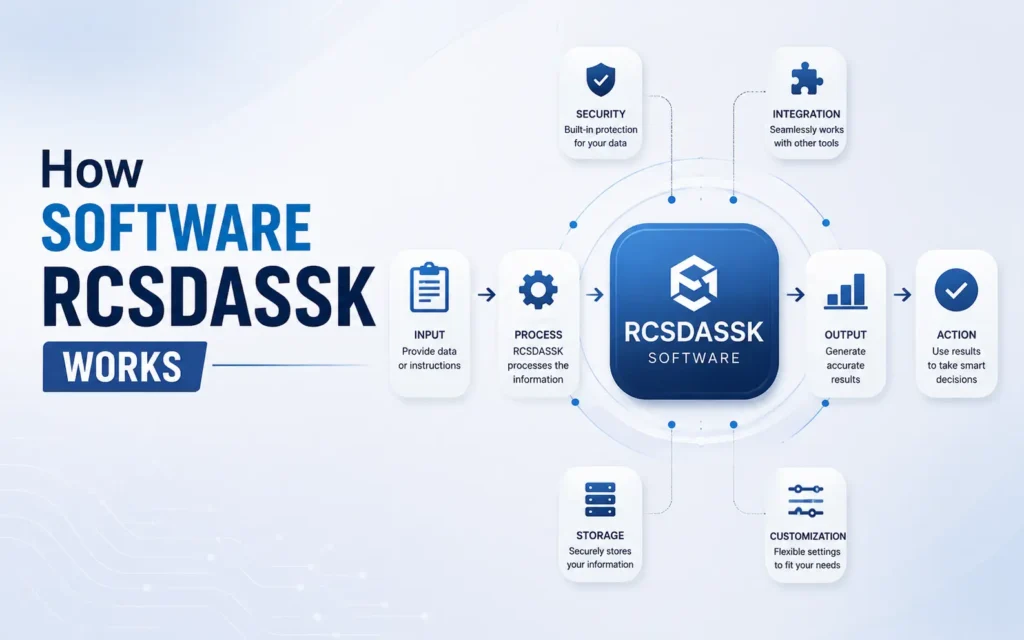
Software RCSDASSK typically begins with understanding a company’s operational requirements. Every organisation follows unique processes, so the platform focuses on identifying existing workflows before recommending suitable configurations. This tailored approach ensures automation supports real business goals rather than forcing organisations to adjust to rigid software frameworks.
Once the requirements have been defined, the system is configured to support essential business activities. Information from various departments can be organised within a shared environment, allowing employees to access consistent and up-to-date data whenever needed. Centralising operations reduces duplication, minimises communication gaps, and creates a more reliable foundation for decision-making.
As daily operations continue, automated workflows perform routine actions based on predefined rules. Instead of manually repeating the same tasks each day, businesses can rely on the software to process information efficiently while maintaining operational accuracy. Managers remain informed through reporting dashboards that provide continuous insight into performance, enabling timely adjustments whenever business priorities change.
Industries That Can Benefit from Software RCSDASSK
Software RCSDASSK is designed to adapt to different operational environments rather than serving a single niche. Businesses across multiple industries often face similar challenges, including fragmented data, repetitive administrative work, delayed reporting, and disconnected teams. By bringing essential processes into one platform, the software helps organisations improve efficiency without overcomplicating daily operations.
Manufacturing companies can use the platform to coordinate production schedules, monitor inventory levels, and streamline communication between procurement and operations. Having real-time visibility into these processes reduces delays and supports better resource planning. Trading businesses benefit from centralised order management, supplier coordination, and sales tracking, allowing them to respond more quickly to market demands.
Educational institutions also require efficient systems to manage student records, staff administration, scheduling, and internal workflows. A unified platform simplifies these responsibilities while reducing the amount of manual data handling. In e-commerce, where order volumes and customer expectations continue to grow, Software RCSDASSK can support inventory management, fulfilment workflows, and customer information within a single environment, helping businesses maintain consistency as they scale.
Service-based organisations, logistics providers, and growing enterprises can also benefit from a platform that connects departments instead of relying on isolated software solutions. The result is smoother collaboration, better visibility into operations, and more informed decision-making across the business.
📌 More on This Topic: Best Inbound Marketing Tools to Boost Traffic, Generate Leads & Increase Sales
Benefits of Using Software RCSDASSK
The biggest advantage of Software RCSDASSK lies in its ability to replace scattered processes with a structured operational system. When business information is centralised, employees spend less time searching for data or switching between applications. This creates a more organised workflow and allows teams to focus on activities that directly contribute to business growth.
Automation further enhances productivity by reducing repetitive tasks. Processes such as updating records, tracking operational progress, or managing routine approvals can often be completed with minimal manual involvement. Besides improving efficiency, automation also reduces the likelihood of human error, leading to more reliable business outcomes.
Another important benefit is improved collaboration. Departments frequently depend on shared information, yet disconnected systems often create communication gaps. With a unified platform, teams can access consistent data, making it easier to coordinate projects, monitor progress, and respond to changing priorities. This transparency strengthens accountability while supporting faster decision-making.
Scalability is equally valuable for expanding businesses. As organisations grow, operational complexity increases, making manual processes increasingly difficult to manage. Software RCSDASSK provides a framework that can evolve alongside business requirements, allowing companies to expand operations without completely redesigning their internal systems.
Decision-makers also gain access to organised reporting that reflects current business performance rather than outdated information. Accurate insights help managers identify trends, evaluate operational efficiency, and address issues before they become significant challenges. Reliable data ultimately supports smarter planning and more confident business decisions.
Common Business Challenges Software RCSDASSK Helps Solve
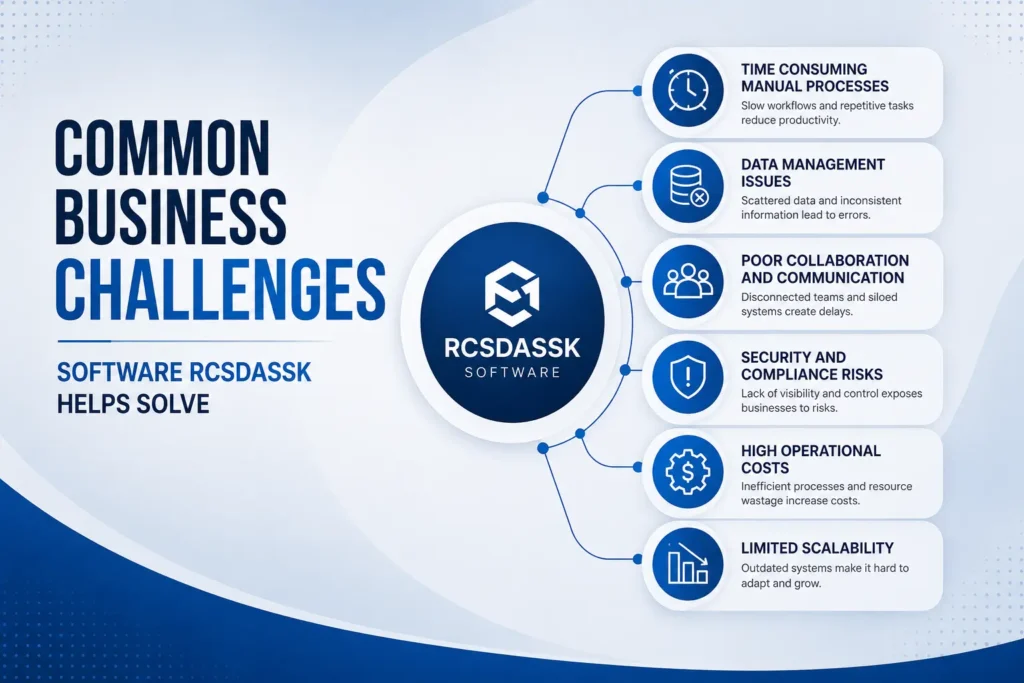
Many organisations continue to rely on disconnected software for different departments. Sales teams may use one platform, finance another, and operations a completely separate system. While each application serves its purpose, the lack of integration often creates duplicate work and inconsistent information.
Software RCSDASSK addresses this issue by providing a central location where business data can be managed more effectively. Instead of repeatedly entering the same information across multiple systems, employees work from a shared source of information that improves accuracy and consistency.
Manual processes represent another common obstacle. Repetitive administrative tasks consume valuable time while increasing the risk of mistakes. Automation reduces this burden by allowing routine activities to follow predefined workflows, helping businesses complete work more efficiently without sacrificing accuracy.
Delayed reporting also affects business performance. When managers receive outdated information, opportunities may already have been missed. Centralised reporting allows decision-makers to monitor operations continuously, making it easier to identify trends, evaluate performance, and respond to changing conditions on time.
Communication between departments often improves as well. When everyone works from the same information, misunderstandings become less frequent, projects move forward more smoothly, and teams can collaborate with greater confidence.
Getting Started with Software RCSDASSK
Successful implementation begins with understanding business objectives rather than installing software immediately. Organisations should first evaluate their existing workflows, identify operational bottlenecks, and determine which processes would benefit most from automation. This assessment provides a clear foundation for configuring the platform according to actual business needs.
One of the platform’s distinguishing characteristics is its emphasis on customised demonstrations. Instead of presenting a generic solution, businesses are encouraged to share their operational requirements so the system can be tailored to their environment. This helps decision-makers understand how the software fits into existing workflows before committing to implementation.
After the initial configuration, employee onboarding becomes an important part of adoption. Even user-friendly software requires teams to understand new processes and responsibilities. Short training sessions combined with practical guidance can significantly improve adoption rates while reducing resistance to change.
Once deployed, organisations should continue monitoring system performance and gather feedback from employees. Business operations evolve, and software should evolve with them. Periodic reviews allow companies to refine workflows, improve automation, and ensure the platform continues supporting long-term operational goals.
Software RCSDASSK Use Cases
The flexibility of Software RCSDASSK allows it to support a wide range of operational activities across different departments. Sales teams can use it to maintain customer records, monitor leads, and follow the progress of ongoing opportunities without relying on separate systems. Keeping customer information in one place improves visibility and enables more consistent client interactions.
Operations teams can coordinate daily activities through automated workflows that reduce administrative overhead and improve process consistency. Inventory tracking becomes more reliable when stock information is updated centrally, helping businesses avoid shortages or unnecessary overstocking.
Human resources departments may also benefit from streamlined employee management, attendance monitoring, and internal documentation. Meanwhile, finance teams can access organised operational data that supports reporting and planning without spending excessive time consolidating information from multiple sources.
These use cases demonstrate that Software RCSDASSK is not limited to a single function. Instead, it serves as a connected operational platform that helps businesses simplify complex processes, improve collaboration, and create a more efficient working environment regardless of industry or organisational size.
📌 More on This Topic: Top Higher Education Marketing Automation Tools for Smarter Student
Understanding the RCSDASSK Configuration Error
Besides being recognised as a business software platform, RCSDASSK is also associated with a configuration-related system error. This issue generally appears when the software cannot initialise correctly because essential settings, dependencies, or system components are missing or incorrectly configured. Although the exact cause varies by environment, configuration errors usually prevent the application from performing as expected.
Users may notice slow performance, failed startup attempts, interrupted workflows, or unexpected system messages. In some cases, the software may launch but certain modules remain inaccessible due to incomplete configuration. These symptoms often indicate that the application is unable to communicate with required resources or validate its operating environment.
Configuration problems can occur after software updates, incomplete installations, changes to system permissions, or conflicts with other applications. Identifying the underlying cause is important because the visible error is often a symptom rather than the root problem.
How to Fix the RCSDASSK Error
Resolving the RCSDASSK error begins with verifying that the software has been installed correctly. Missing files or interrupted installations can prevent essential components from loading, making a fresh installation one of the simplest ways to eliminate corrupted program files.
System compatibility should also be reviewed. Running software on an unsupported operating system or outdated framework can trigger unexpected behaviour during startup. Keeping both the operating system and application updated helps minimise compatibility-related issues while improving stability and security.
Configuration settings deserve careful attention as well. Incorrect database connections, invalid file paths, or incomplete environment variables can all interfere with normal operation. Reviewing these settings against the recommended configuration often resolves problems that appear immediately after deployment.
Access permissions are another common factor. If the application lacks sufficient privileges to read configuration files or communicate with required services, certain features may fail to initialise correctly. Ensuring that users and system processes have the appropriate permissions reduces the likelihood of recurring errors.
When troubleshooting does not resolve the issue, consulting official documentation or contacting the software provider is the most reliable next step. Vendor support teams can often identify environment-specific problems that are difficult to diagnose through general troubleshooting alone.
Best Practices for Using Software RCSDASSK
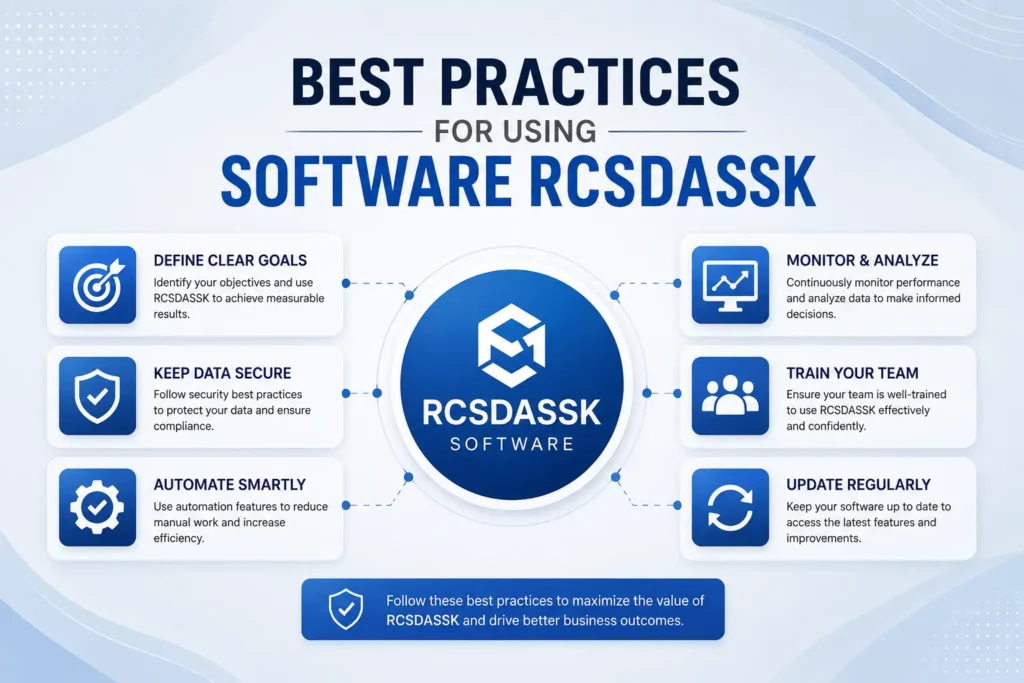
Long-term success with any business software depends as much on operational discipline as it does on technology. Regular software updates ensure that new features, performance improvements, and security patches are applied promptly. Using outdated versions can increase security risks while preventing organisations from benefiting from the latest improvements.
Routine data backups provide another layer of protection. Business information is one of an organisation’s most valuable assets, and maintaining reliable backups helps minimise disruption if unexpected technical issues occur. A structured backup strategy also supports faster recovery during system maintenance or hardware failures.
Employee training should not be overlooked. Even intuitive software delivers better results when users understand how individual features contribute to broader business workflows. Continuous learning encourages consistent usage and helps teams take full advantage of automation capabilities.
Monitoring system performance allows organisations to identify inefficiencies before they affect productivity. Reviewing reports, analysing workflow performance, and gathering employee feedback create opportunities to refine processes over time. As business needs evolve, periodic adjustments ensure the platform continues supporting operational goals efficiently.
Software RCSDASSK vs Traditional Business Software
Traditional business software often focuses on solving a single operational challenge. One application may manage accounting, another handles inventory, while a separate system supports customer relationships. While this approach may be effective, it often leads to fragmented information and increased administrative workload.
Software RCSDASSK takes a broader approach by combining multiple operational functions within one connected environment. Instead of moving data between separate applications, departments work from a shared source of information that improves consistency and collaboration. This integrated model helps reduce duplicate work while giving decision-makers a clearer view of overall business performance.
Another important difference lies in flexibility. Conventional software packages may require businesses to adapt their workflows to predefined processes. Software RCSDASSK, by contrast, emphasises customisation based on organisational requirements, making it more suitable for companies seeking tailored operational solutions rather than fixed functionality.
The right choice ultimately depends on business objectives, existing infrastructure, and long-term growth plans. Organisations with straightforward operational needs may find specialised software sufficient, while businesses managing multiple interconnected processes often benefit more from an integrated platform.
Conclusion
Software RCSDASSK represents a modern approach to business management by bringing automation, operational control, and centralised information into a single platform. Its focus on customisation and workflow efficiency makes it relevant for organisations looking to simplify everyday operations without relying on multiple disconnected systems.
At the same time, understanding the RCSDASSK configuration error is equally important for users responsible for deploying or maintaining the software. Most technical issues can be resolved by reviewing installation procedures, validating system settings, and keeping the software environment properly maintained.
As businesses continue adopting digital solutions to improve productivity, platforms that combine flexibility, automation, and scalability will remain valuable. Whether your goal is to streamline operations or resolve configuration challenges, taking a structured approach to implementation and maintenance will help you achieve more reliable and efficient results.
Frequently Asked Questions
What is Software RCSDASSK?
Software RCSDASSK is described as an all-in-one business management platform that helps organisations automate workflows, centralise business data, and improve operational efficiency across industries such as manufacturing, trading, education, and e-commerce.
Does Software RCSDASSK require technical expertise?
The platform is built for both technical and non-technical users, making it easy to adopt across teams. Businesses typically provide their operational requirements first, after which a customised demonstration and configuration process helps simplify implementation.
What causes the RCSDASSK configuration error?
The error is commonly linked to incomplete installations, incorrect configuration settings, compatibility issues, missing system components, or insufficient user permissions. Identifying the underlying cause is essential for successful troubleshooting.
Can Software RCSDASSK support growing businesses?
Yes. Because the platform focuses on automation and integrated business management, it can scale alongside organisational growth by supporting additional workflows, users, and operational requirements without relying on multiple disconnected systems.
Is Software RCSDASSK suitable for every business?
Software RCSDASSK is most valuable for organisations seeking to automate processes, improve collaboration, and manage operations from a unified platform. However, businesses should evaluate their specific requirements and request a customised demonstration to determine whether the solution aligns with their operational goals.
💡 Learn today. Rank tomorrow. Follow Spy Growth.