
12 Best Inbound Marketing Tools to Boost Traffic, Generate Leads & Increase Sales
Reaching the right audience has become more challenging than ever. Consumers no longer rely on advertisements alone when choosing a product or service. Instead, they research online, compare options, read reviews, and expect brands to provide valuable information before making a decision. This shift has made inbound marketing one of the most effective strategies for sustainable business growth.
Inbound marketing focuses on attracting potential customers by creating helpful content and meaningful experiences instead of interrupting them with promotional messages. Whether someone discovers your business through a Google search, a blog post, an email newsletter, or social media, the goal remains the same: build trust before making a sale.
Managing every stage of this process manually is difficult. Businesses often struggle to create content consistently, optimise it for search engines, nurture leads, track customer behaviour, and measure campaign performance. This is where inbound marketing tools make a significant difference.
These tools simplify complex marketing tasks by bringing content creation, SEO, email marketing, customer relationship management, automation, and analytics into a structured workflow. Rather than replacing marketers, they help teams work more efficiently while improving the customer experience.
In this guide, you’ll learn what inbound marketing tools are, why they matter, the different categories available, and how to choose the right solutions for your business.
What Are Inbound Marketing Tools?
Inbound marketing tools are software applications designed to help businesses attract visitors, convert them into leads, nurture relationships, and turn those leads into loyal customers. Instead of pushing promotional messages toward a broad audience, these platforms support strategies that naturally draw people to your brand.
The customer journey usually begins when someone searches for information online. A well-optimised blog, educational guide, or useful resource answers that search intent and introduces your business. From there, email campaigns, personalised content, CRM systems, and marketing automation continue building the relationship until the visitor is ready to make a purchase.
Without the right tools, managing this process becomes time-consuming and inconsistent. Inbound marketing platforms centralise multiple marketing activities, making it easier to publish content, monitor engagement, automate communication, and evaluate performance from a single dashboard.
Modern solutions also incorporate artificial intelligence to improve content recommendations, personalise customer experiences, identify qualified leads, and automate repetitive workflows. This allows businesses to focus more on strategy while reducing manual effort.
Why Businesses Use Inbound Marketing Tools
Today’s buyers expect relevant, personalised experiences. Generic advertising rarely produces the same level of engagement it once did because customers prefer brands that educate rather than simply sell.
Inbound marketing tools help businesses create those experiences by connecting every stage of the customer journey. They allow marketers to understand audience behaviour, publish high-quality content consistently, automate follow-up communication, and measure results with greater accuracy.
These platforms also improve collaboration across marketing and sales teams. Customer information, campaign performance, website activity, and lead interactions remain organised in one place, reducing missed opportunities and improving decision-making.
For growing businesses, automation becomes especially valuable. Instead of manually sending emails, updating contact lists, or monitoring every campaign, teams can create automated workflows that continue working around the clock while maintaining a personalised experience.
Benefits of Using Inbound Marketing Tools
The biggest advantage of inbound marketing tools is efficiency. Businesses can manage multiple marketing activities without increasing their workload, allowing teams to accomplish more with fewer resources.
These platforms also improve lead quality. Rather than attracting random visitors, businesses can create targeted content that answers specific customer questions. This attracts people who are genuinely interested in the products or services being offered, increasing the likelihood of conversion.
Another major benefit is stronger customer relationships. Automated email sequences, personalised recommendations, and timely communication help businesses stay connected with prospects throughout the buying journey without overwhelming them.
Accurate analytics provide another competitive advantage. Marketing decisions are now driven by data, not assumptions. Businesses can monitor website traffic, conversion rates, customer behaviour, and campaign performance to identify what is working and where improvements are needed.
Scalability is equally important. As a business grows, marketing becomes more complex. Inbound marketing tools make it easier to expand campaigns, manage larger audiences, and maintain consistency without rebuilding existing processes.
Perhaps most importantly, these tools support long-term growth. Unlike short-term advertising campaigns that stop generating results once spending ends, inbound strategies continue attracting visitors through valuable content, strong SEO, and lasting customer relationships.
Types of Inbound Marketing Tools
Inbound marketing covers several marketing activities, and each requires specialised software to achieve the best results. Instead of relying on one solution for every task, businesses often combine different tools that work together within a unified strategy.
Content marketing tools simplify planning, writing, editing, and publishing articles, landing pages, and educational resources that attract organic traffic. They help maintain consistency while ensuring content aligns with audience interests.
SEO tools focus on improving online visibility by identifying valuable keywords, analysing competitors, monitoring rankings, and uncovering technical issues that may limit search performance. These insights allow businesses to create content that matches user intent while increasing their chances of appearing in search results.
Email marketing platforms strengthen customer relationships through personalised campaigns, automated follow-ups, and audience segmentation. Instead of sending the same message to everyone, businesses can deliver relevant content based on user behaviour and interests.
Customer relationship management systems organise contact information, sales activities, and customer interactions in one place. Combined with marketing automation software, they create seamless workflows that guide prospects from their first website visit to becoming long-term customers.
The remaining categories, including social media management, analytics, live chat, and landing page builders, play equally important roles in creating a complete inbound marketing ecosystem. Understanding these tools and choosing the right combination can significantly improve both marketing performance and customer experience.
🌟 Expand Your Knowledge: Small Business Marketing Tips 2026
Best Inbound Marketing Tools in 2026
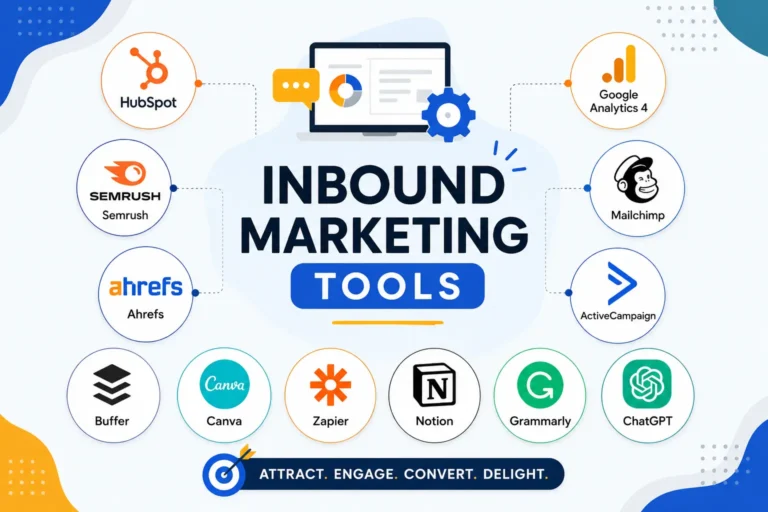
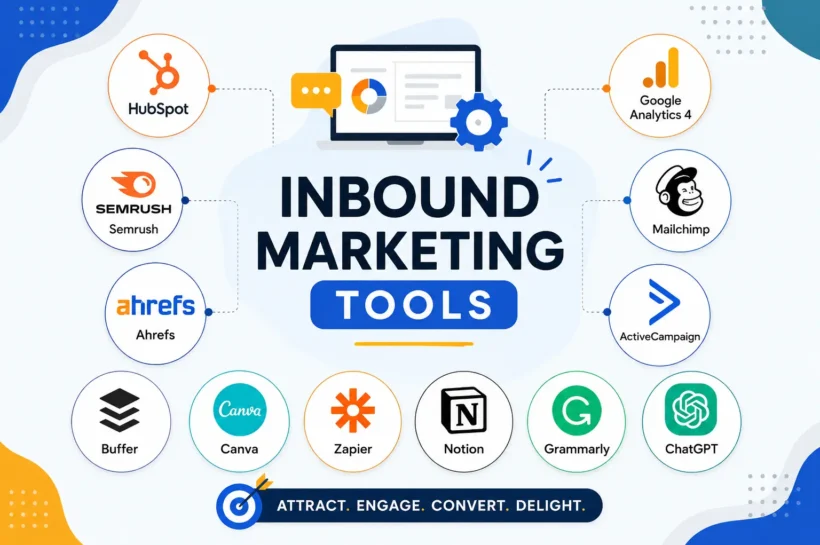
Choosing the right inbound marketing tools is not about finding one platform that does everything. The most successful businesses build a stack of tools that work together, allowing them to attract visitors, convert leads, nurture relationships, and measure performance without creating unnecessary complexity. The following tools consistently stand out because of their reliability, feature set, and ability to support businesses of different sizes.
HubSpot
HubSpot remains one of the most complete inbound marketing platforms available. It combines CRM, email marketing, content management, landing pages, automation, live chat, and analytics into a single ecosystem. This all-in-one approach reduces the need for multiple disconnected tools while giving marketing and sales teams a unified view of every customer interaction.
The platform is particularly valuable for businesses that want to automate lead nurturing without sacrificing personalisation. As companies grow, HubSpot scales with them, making it a popular choice for startups, SaaS businesses, agencies, and enterprises alike.
Semrush
Search engine optimisation sits at the heart of inbound marketing, and Semrush provides everything needed to improve online visibility. From keyword research and competitor analysis to technical audits and backlink monitoring, it helps marketers identify opportunities that drive sustainable organic traffic.
Beyond SEO, Semrush includes content optimisation, advertising research, and social media management features. This makes it useful for marketers looking to build campaigns based on real search data rather than assumptions.
Ahrefs
Ahrefs is widely recognised for its backlink database and competitive analysis capabilities. Businesses use it to discover how competitors earn traffic, identify high-value keywords, and uncover link-building opportunities that strengthen domain authority.
Its content analysis features also help marketers identify topics with strong ranking potential, making it easier to create articles that answer user intent while improving search performance over time.
Google Analytics 4
Understanding user behaviour is essential for improving any marketing strategy. Google Analytics 4 provides detailed insights into how visitors interact with a website, where they come from, which pages they engage with, and what actions they complete before converting.
Instead of relying on guesswork, marketers can use this data to refine content, improve user experience, and identify areas that require optimisation. These insights help businesses make informed decisions that improve long-term marketing performance.
Mailchimp
Email remains one of the highest-performing inbound marketing channels, and Mailchimp continues to be a dependable solution for businesses of all sizes. It simplifies email campaign creation while offering audience segmentation, automation, performance reporting, and template management.
For small businesses and growing brands, Mailchimp provides an accessible way to build stronger customer relationships through consistent and personalised communication.
ActiveCampaign
Businesses looking for advanced automation often choose ActiveCampaign. The platform combines email marketing with CRM functionality and sophisticated automation workflows that respond to customer behaviour in real time.
Whether someone downloads an ebook, visits a pricing page, or abandons a form, automated sequences can deliver relevant messages without manual intervention. This creates a smoother customer journey while improving lead conversion.
Buffer
Maintaining an active social media presence supports inbound marketing by extending the reach of valuable content. Buffer helps businesses schedule posts, manage multiple social accounts, and analyse engagement from a single dashboard.
Its simple interface makes content publishing more consistent, allowing marketing teams to focus on creating meaningful conversations instead of manually posting throughout the day.
Canva
Visual content has become an essential part of digital marketing. Canva enables marketers to create professional graphics, presentations, infographics, and social media visuals without advanced design skills.
High-quality visuals improve engagement across blogs, emails, and social platforms while reinforcing brand consistency throughout every marketing campaign.
Zapier
Marketing teams often use several tools simultaneously, creating repetitive manual tasks. Zapier solves this problem by connecting thousands of applications and automating routine workflows.
For example, a new website lead can automatically be added to a CRM, enrolled in an email campaign, and assigned to a sales representative without requiring manual input. These automations reduce errors while saving valuable time.
Notion
Successful inbound marketing depends on organised planning. Notion provides a central workspace where teams can manage editorial calendars, campaign documentation, content briefs, and project collaboration.
Keeping ideas, deadlines, and workflows organised helps marketing teams publish content consistently while improving communication across departments.
Grammarly
Strong content builds trust, but even small grammar mistakes can affect credibility. Grammarly assists writers by improving grammar, spelling, clarity, and tone while maintaining readability.
Although it should not replace human editing, it serves as an effective quality-control tool before publishing blogs, emails, and marketing copy.
ChatGPT
Artificial intelligence has transformed content creation, and ChatGPT has become a valuable assistant for marketers. It can generate content ideas, create outlines, improve copy, brainstorm campaigns, summarise research, and refine messaging in significantly less time.
However, the best results come when AI supports human expertise rather than replacing it. Fact-checking, editing, and adding original insights remain essential for creating authoritative content that builds trust with readers.
Free vs Paid Inbound Marketing Tools
Many businesses begin with free tools, and for good reason. Platforms such as Google Analytics, Canva, and Mailchimp offer generous free plans that allow teams to build a solid marketing foundation without significant investment.
As businesses expand, however, limitations become more noticeable. Advanced automation, detailed reporting, CRM integrations, larger contact databases, and collaboration features are often reserved for paid plans. At this stage, upgrading becomes less about accessing extra features and more about improving efficiency and supporting growth.
The decision should not depend solely on price. Instead, businesses should evaluate whether a paid solution saves enough time, improves lead quality, or increases revenue to justify the investment. In many cases, the long-term return outweighs the subscription cost.
How to Choose the Right Inbound Marketing Tools
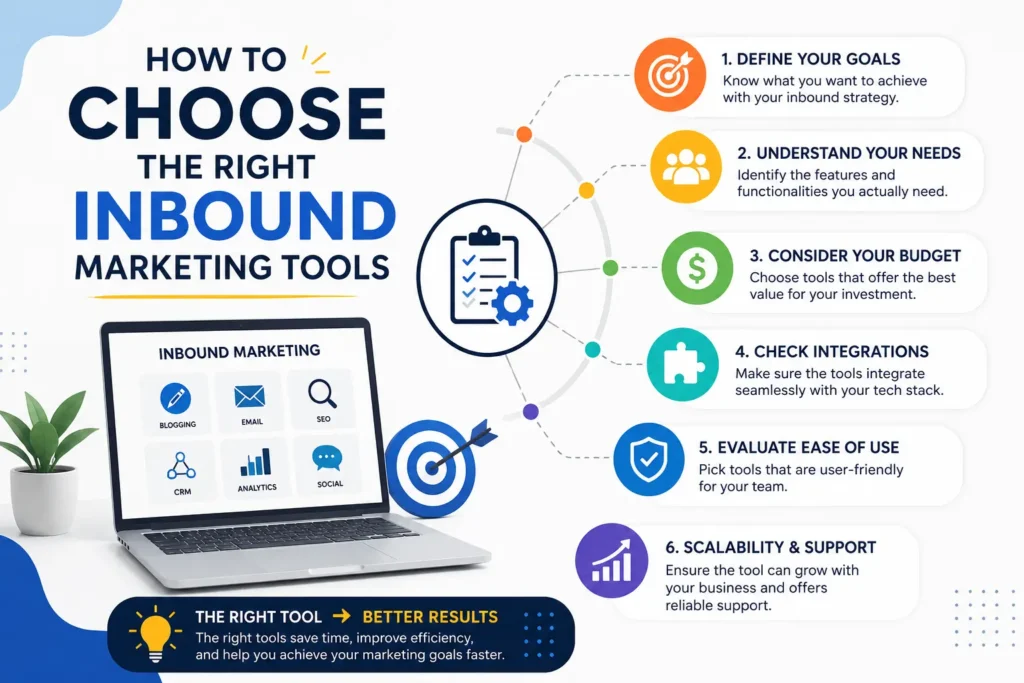
Selecting the right software starts with understanding your marketing objectives. A company focused on increasing organic traffic will prioritise SEO and content tools, while another aiming to improve customer retention may invest more heavily in CRM and email automation.
Ease of use is another important consideration. Powerful software delivers little value if teams struggle to adopt it. Choosing intuitive platforms reduces training time and encourages consistent usage across departments.
Integration should also influence every decision. Marketing tools perform best when they share information seamlessly. Connecting your CRM, email platform, analytics, and automation software creates a smoother workflow while reducing duplicated effort.
Finally, consider long-term scalability. The tools you choose today should continue supporting your business as traffic, customers, and marketing campaigns grow. Investing in flexible platforms helps avoid expensive migrations later while ensuring your technology evolves alongside your business.
Essential Features to Look for in Inbound Marketing Tools
Not every inbound marketing platform offers the same capabilities, which is why evaluating core features is more important than comparing lengthy feature lists. The best tools simplify your workflow while supporting every stage of the customer journey.
Automation should be a priority. Repetitive tasks such as sending follow-up emails, assigning leads, or updating customer records consume valuable time when handled manually. Automation ensures these actions happen consistently, allowing teams to focus on strategy instead of routine work.
Integration is equally important. Marketing tools should connect seamlessly with your CRM, analytics platform, email software, and content management system. A connected ecosystem eliminates data silos and provides a clearer picture of customer behaviour.
Analytics and reporting help measure what matters. Reliable dashboards reveal where traffic comes from, how visitors engage with content, and which campaigns generate the highest conversions. These insights make it easier to optimise future marketing efforts.
Artificial intelligence has also become a valuable feature rather than a luxury. Modern platforms use AI to recommend content ideas, personalise customer experiences, predict user behaviour, and automate repetitive processes. When combined with human expertise, these capabilities improve both efficiency and marketing performance.
Finally, look for software that remains easy to use as your business grows. A platform should support your future needs without becoming unnecessarily complex.
🌟 Expand Your Knowledge: Best Marketing Tools for Photographers
Common Mistakes to Avoid
Many businesses invest in marketing software expecting immediate results, only to discover that success depends on strategy rather than technology alone. Avoiding a few common mistakes can significantly improve the return on your investment.
One of the biggest mistakes is using too many tools at once. A crowded tech stack often creates unnecessary complexity, increases costs, and makes workflows harder to manage. Choosing a smaller number of well-integrated platforms usually produces better results.
Another common issue is ignoring analytics. Publishing content without reviewing performance means valuable opportunities are missed. Regularly analysing traffic, engagement, and conversion data helps identify what deserves greater attention and what needs improvement.
Businesses also underestimate the importance of automation. Repeating manual tasks not only wastes time but also increases the risk of inconsistency. Even simple automated workflows can improve efficiency while creating a better customer experience.
Selecting software based solely on price is another costly mistake. While affordability matters, the lowest-cost solution may not provide the features needed for long-term growth. Evaluating overall value instead of initial cost often leads to better decisions.
Finally, even the best platform requires proper adoption. Investing time in learning the software and training your team ensures you take full advantage of its capabilities instead of using only a small fraction of its potential.
Best Inbound Marketing Tool Stack for Different Businesses
Every business has unique goals, which means there is no universal combination of inbound marketing tools. The ideal stack depends on your industry, company size, budget, and marketing objectives.
Small businesses often benefit from simple, affordable solutions that cover essential functions such as email marketing, SEO, analytics, and customer management. These tools provide a strong foundation without creating unnecessary complexity.
Startups usually prioritise scalability. They need platforms that can support rapid growth while keeping operations efficient. Combining a CRM with automation, analytics, and SEO software allows startups to expand their marketing without constantly replacing existing systems.
SaaS companies rely heavily on content marketing, lead nurturing, and customer retention. Their technology stack typically emphasises automation, behavioural analytics, customer relationship management, and search engine optimisation to attract and convert highly qualified prospects.
Marketing agencies require collaboration, reporting, and multi-client management. Platforms that centralise campaigns, monitor performance, and streamline communication help agencies deliver consistent results while managing multiple accounts efficiently.
Large enterprises often integrate comprehensive marketing platforms with advanced analytics, automation, and customer data solutions to coordinate campaigns across multiple teams, regions, and customer segments.
Regardless of business size, the most effective technology stack is the one that aligns with clear marketing goals while remaining easy to manage and scale.
🌟 Expand Your Knowledge: AI Tools for Affiliate Marketing
How AI Is Changing Inbound Marketing Tools
Artificial intelligence is reshaping inbound marketing by helping businesses work smarter rather than simply faster. Instead of replacing marketers, AI enhances decision-making, improves efficiency, and delivers more personalised customer experiences.
Content creation has become significantly more efficient with AI-assisted research, drafting, editing, and optimisation. Marketers can develop high-quality content more quickly while dedicating more time to refining strategy and adding original expertise.
AI also strengthens personalisation by analysing customer behaviour and recommending relevant content based on individual interests. This creates more meaningful interactions and increases the likelihood of conversion.
Predictive analytics is another major advancement. By identifying behavioural patterns, AI helps businesses anticipate customer needs, qualify leads more accurately, and optimise marketing campaigns before performance declines.
Customer support has also evolved through intelligent chatbots capable of answering common questions, qualifying prospects, and directing users to relevant resources at any time of day. This improves responsiveness while allowing support teams to focus on more complex conversations.
As AI continues to advance, businesses that combine automation with valuable human insight will be better positioned to build trust, improve efficiency, and remain competitive.
Conclusion
Inbound marketing is no longer just a strategy for attracting visitors, it is a framework for building lasting customer relationships. The right tools make this process more efficient by helping businesses create valuable content, improve search visibility, automate communication, manage customer interactions, and measure performance with confidence.
There is no single platform that suits every organisation. The best choice depends on your goals, budget, team size, and long-term growth plans. Instead of chasing the largest collection of features, focus on tools that solve real business challenges and integrate seamlessly with your existing workflow.
As artificial intelligence continues to transform digital marketing, businesses that combine reliable technology with authentic, high-quality content will have the strongest competitive advantage. By selecting the right inbound marketing tools and using them strategically, you can attract qualified leads, strengthen customer relationships, and build sustainable growth for years to come.
FAQs
What are inbound marketing tools?
Inbound marketing tools are software solutions that help businesses attract visitors, generate leads, automate marketing activities, manage customer relationships, and measure campaign performance through channels such as SEO, content marketing, email marketing, and analytics.
Which inbound marketing tool is best for beginners?
For beginners, HubSpot, Mailchimp, Canva, Google Analytics 4, and ChatGPT offer an excellent starting point. They are easy to learn and cover the core aspects of inbound marketing without requiring advanced technical knowledge.
Are free inbound marketing tools enough for small businesses?
Yes, many small businesses can achieve strong results using free tools during the early stages. As marketing efforts grow, upgrading to paid plans often provides additional automation, integrations, reporting, and scalability that support long-term business growth.
How do inbound marketing tools improve SEO?
SEO tools help identify valuable keywords, analyse competitors, monitor rankings, detect technical issues, and optimise content for search intent. These improvements increase organic visibility and attract more qualified traffic over time.
Can AI replace inbound marketing tools?
No. AI enhances inbound marketing tools by improving automation, content creation, data analysis, and personalisation. Still, it cannot replace strategic planning, creativity, or the human expertise required to build trust and produce authoritative content.
🔷 Better content starts here. Follow Spy Growth.