
Best Video Marketing Tools for Businesses in 2026
Video has become one of the most effective ways to capture attention, explain ideas, and influence buying decisions. Whether someone discovers a brand through social media, search engines, email campaigns, or a company website, video often creates the strongest first impression. Recent industry research from organizations like Wyzowl, HubSpot, and Statista consistently shows that businesses continue to increase their investment in video because it improves engagement, builds trust, and supports higher conversion rates.
Creating high-quality videos, however, requires more than creativity. Planning, editing, publishing, and measuring performance can quickly become time-consuming without the right technology. This is where video marketing tools make a significant difference. Instead of handling every task manually, marketers can streamline production, collaborate with team members, optimize videos for different platforms, and monitor campaign performance from a single workflow.
The market now offers hundreds of video marketing solutions, each designed for different goals. Some focus on AI-powered video creation, while others specialize in professional editing, social media publishing, analytics, or video hosting. Choosing the right software depends on your objectives, budget, and level of experience rather than simply selecting the most popular platform.
This guide explains what video marketing tools are, why they matter, and which features deserve the most attention before making a decision. By the end, you’ll have a clearer understanding of how to choose software that supports your marketing strategy instead of complicating it.
What Are Video Marketing Tools?
Video marketing tools are software applications that help businesses and content creators produce, edit, publish, distribute, and analyze videos used for marketing purposes. Rather than relying on multiple disconnected applications, these tools simplify the entire video workflow and make professional-quality content more accessible.
Some platforms focus exclusively on editing, while others combine several capabilities into one solution. Modern video marketing software may include AI-assisted editing, automatic subtitle generation, branding features, collaboration options, analytics dashboards, and direct publishing to social media platforms.
Their primary goal is to reduce production time while improving the quality and consistency of marketing videos. Instead of spending hours on repetitive tasks, marketing teams can automate many processes and dedicate more attention to storytelling and campaign strategy.
As artificial intelligence continues to evolve, many video marketing tools now assist with script generation, voiceovers, background removal, and video enhancement. These innovations have lowered the barrier for businesses that previously lacked the resources to produce professional video content.
Why Businesses Need Video Marketing Tools
The growing popularity of video has changed customer expectations. People increasingly prefer watching a short, informative video instead of reading lengthy explanations before making purchasing decisions. Businesses that consistently publish valuable video content often build stronger relationships with their audiences because videos communicate information quickly and naturally.
Video marketing tools make this possible without requiring a large production team. They simplify editing, reduce repetitive work, and allow marketers to create content more consistently across different channels.
Another important advantage is improved efficiency. Marketing campaigns usually involve multiple stakeholders, including writers, designers, editors, and managers. Many modern platforms provide collaboration features that keep everyone working within the same environment, reducing unnecessary revisions and speeding up approvals.
Consistency also becomes easier to maintain. Branding elements such as logos, fonts, colors, and animations can be reused across multiple videos, helping businesses present a recognizable identity regardless of where the content is published.
Performance measurement is another major reason businesses invest in video marketing software. Creating videos without understanding audience behavior often leads to missed opportunities. Analytics tools reveal valuable insights such as watch time, audience retention, engagement rates, click-through rates, and conversion metrics. These reports help marketers improve future campaigns using real performance data rather than assumptions.
The rise of AI has further increased the value of these platforms. Features like automatic captions, intelligent scene detection, voice enhancement, and text-to-video generation allow businesses to create more content in less time while maintaining professional standards.
For organizations managing multiple marketing channels, video marketing tools are no longer optional conveniences. They have become practical solutions for maintaining consistency, improving productivity, and maximizing the return on video investments.
Types of Video Marketing Tools
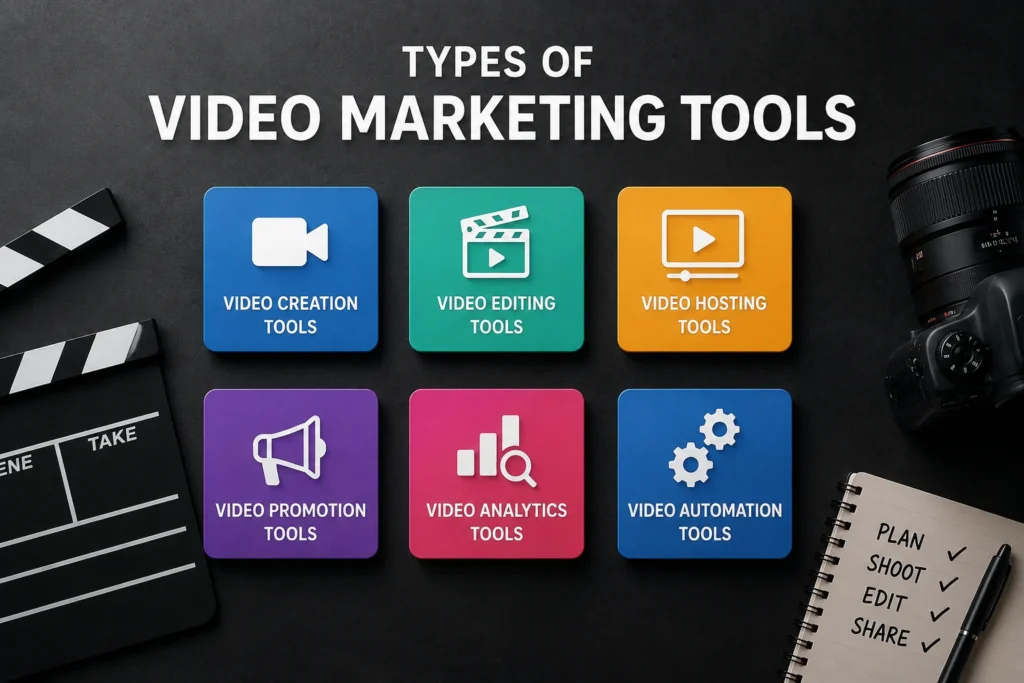
Not every business requires the same type of software because video marketing involves several different stages. Understanding the main categories helps narrow down the options before comparing individual platforms.
Video creation tools are designed for users who want to build videos from templates, images, animations, or stock media without advanced editing knowledge. These platforms are especially useful for small businesses, educators, and marketers who need professional-looking content quickly.
Video editing software offers greater creative control by allowing users to trim clips, add transitions, adjust audio, apply visual effects, and refine every detail of a project. Professional editors often choose these tools for producing polished marketing campaigns and branded content.
AI video generators have emerged as one of the fastest-growing categories. These platforms use artificial intelligence to transform text into videos, generate AI presenters, create voiceovers, or automate editing tasks. They significantly reduce production time while making video creation accessible to non-designers.
Screen recording tools serve businesses that create product demonstrations, tutorials, software walkthroughs, and educational content. Instead of relying on expensive production setups, users can record their screens, webcams, or presentations with minimal effort.
Video hosting platforms provide secure storage, fast playback, customizable video players, and detailed analytics. They are commonly used by businesses that publish webinars, product videos, training materials, or customer success stories while maintaining greater control over branding and audience insights.
Social media publishing platforms help marketers schedule videos across multiple networks, ensuring consistent posting without manually uploading content every day. Many also include performance tracking, allowing teams to evaluate which campaigns generate the strongest engagement.
Understanding these categories makes it easier to identify which features truly matter for your business instead of paying for capabilities that may never be used.
Essential Features to Look for in Video Marketing Tools
Not every video marketing tool is built for the same purpose. Some are designed for quick social media content, while others support professional video production, AI-powered automation, or detailed campaign analytics. Instead of focusing on the software with the longest feature list, choose one that complements your marketing goals and daily workflow.
Ease of use should be your priority. A clean, intuitive interface allows marketers to spend more time creating content and less time learning complicated software. Whether you’re working independently or with a team, a platform that’s easy to navigate can significantly improve productivity.
AI capabilities have also become a major differentiator. Many modern video marketing tools can automatically generate subtitles, remove background noise, enhance audio, create voiceovers, summarize long videos, or even transform text into engaging visual content. These features not only reduce editing time but also make professional-quality videos accessible to users with little technical experience.
Brand customization is another feature worth considering. Consistent branding across every video helps strengthen recognition and build trust with your audience. The ability to save brand colors, logos, fonts, and reusable templates ensures every piece of content reflects a consistent visual identity.
If multiple people contribute to your marketing campaigns, collaboration tools become increasingly valuable. Shared workspaces, cloud storage, commenting systems, and approval workflows help teams work together without constantly exchanging files through email or messaging apps.
Distribution should be just as seamless as production. Many leading platforms let you publish videos directly to YouTube, Facebook, Instagram, LinkedIn, TikTok, and other marketing channels. This simplifies content management while helping maintain a consistent publishing schedule.
Performance tracking is equally important. Analytics such as watch time, audience retention, engagement rate, click-through rate, and conversions reveal how viewers interact with your videos. These insights help marketers identify successful content, improve future campaigns, and make data-driven decisions instead of relying on guesswork.
Finally, consider how well the software fits into your existing marketing stack. Integrations with CRM systems, project management software, cloud storage, email marketing platforms, and content management systems can eliminate repetitive tasks and create a more efficient workflow.
Best Video Marketing Tools to Consider
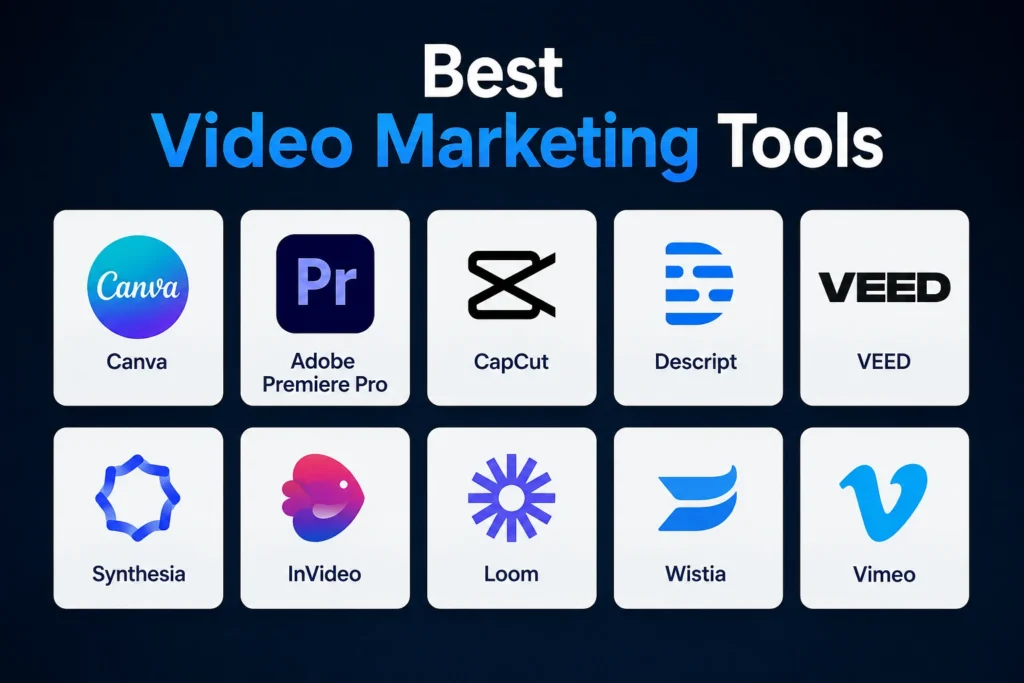
The ideal video marketing tool depends on your objectives, experience level, and the type of content you publish. Some platforms prioritize AI automation, while others focus on professional editing, collaboration, or video hosting. The following tools consistently rank among the most trusted solutions for businesses, creators, and marketing teams.
Canva
Canva has evolved far beyond graphic design and is now one of the most accessible video creation platforms available. Its drag-and-drop editor, extensive template library, and built-in stock media allow users to create professional marketing videos without prior editing experience. It’s particularly well-suited for social media campaigns, promotional videos, presentations, and branded content that need to be produced quickly.
Adobe Premiere Pro
Adobe Premiere Pro remains the industry standard for professional video editing. It offers advanced color correction, motion graphics, audio editing, and seamless integration with other Adobe Creative Cloud applications. While it has a steeper learning curve than beginner-friendly alternatives, it provides the flexibility and creative control required for high-end marketing campaigns.
CapCut
CapCut has become a favorite among marketers creating short-form content for platforms such as TikTok, Instagram Reels, and YouTube Shorts. Its intuitive interface combines powerful editing features with AI-assisted tools like automatic captions, background removal, and smart effects, making it easy to produce engaging videos in less time.
Descript
Descript takes a unique approach by allowing users to edit videos as easily as editing a text document. Its AI-powered transcription, voice cloning, screen recording, and podcast editing capabilities make it especially valuable for webinars, tutorials, interviews, online courses, and educational content where spoken communication plays a central role.
VEED
VEED is a browser-based video editor designed for speed and collaboration. Without installing any software, users can edit videos, generate subtitles, translate captions, add branding, and export content optimized for multiple platforms. Its simplicity makes it a practical solution for remote marketing teams and businesses producing content on a regular basis.
Synthesia
Synthesia specializes in AI-generated videos featuring realistic digital presenters. Businesses use it to create product demonstrations, employee training, onboarding materials, multilingual marketing campaigns, and explainer videos without hiring actors or setting up traditional video shoots. It is particularly valuable for organizations looking to scale video production efficiently.
InVideo
InVideo offers thousands of professionally designed templates that simplify the creation of promotional videos, advertisements, social media posts, and product showcases. Its AI-powered editing features and beginner-friendly interface make it an attractive option for marketers who need polished videos without investing significant time in manual editing.
Loom
Loom focuses on screen recording and video communication rather than traditional editing. Sales professionals, customer support teams, educators, and SaaS businesses frequently use it to create product demonstrations, software walkthroughs, personalized messages, and internal training videos that feel more personal than written communication.
Wistia
Wistia combines secure video hosting with business-focused marketing features. Beyond simply storing videos, it provides detailed analytics, customizable players, lead generation tools, and audience engagement reports. These capabilities help businesses understand viewer behavior while maintaining complete control over their branded video experience.
Vimeo
Vimeo is widely recognized for delivering high-quality video hosting with advanced privacy controls, collaboration tools, and reliable streaming performance. Businesses often choose Vimeo for webinars, product launches, customer education, and premium branded content where presentation quality and security are top priorities.
How to Choose the Right Video Marketing Tool
Choosing the right video marketing tool starts with understanding your marketing objectives rather than comparing feature lists. A business focused on creating educational tutorials will have very different requirements from one that produces short-form videos for social media or AI-generated product demonstrations.
Your team’s skill level should also influence your decision. Professional editing software offers exceptional flexibility but often requires considerable training. If speed and simplicity matter more than advanced editing, a user-friendly platform may deliver better long-term results.
Budget deserves careful consideration, but it shouldn’t be the only deciding factor. Free tools work well for occasional content creation, while premium software often includes collaboration features, automation, branding capabilities, advanced analytics, and customer support that become increasingly valuable as your marketing efforts grow.
Before committing to any subscription, spend time exploring free trials or demo versions. Testing real workflows provides a much clearer picture of how the software performs than simply comparing feature pages. The best video marketing tool is ultimately the one that helps your team create better content more efficiently.
Common Mistakes to Avoid
One of the biggest mistakes businesses make is choosing software based solely on popularity. A platform may be highly rated, but if it doesn’t match your workflow or content strategy, it can quickly become an unnecessary expense.
Another common error is prioritizing price over value. While free tools are excellent for beginners, they often come with limitations that can slow production as your marketing needs expand. Investing in software that supports long-term growth usually delivers a better return than constantly switching platforms.
Many marketers also underestimate the importance of analytics. Producing high-quality videos is only half the equation. Without understanding viewer behavior, engagement, and conversions, it’s difficult to improve future campaigns or measure marketing success.
Finally, avoid paying for advanced features you’ll rarely use. A streamlined platform that fits your daily workflow will almost always outperform a complex solution filled with capabilities that remain untouched.
📑 You May Also Like: Backlinks Software
Tips for Getting Better Results from Video Marketing Tools
Choosing the right software is only part of the equation. The real value comes from how effectively you use it to support your marketing strategy. Even the most advanced video marketing tools cannot compensate for weak messaging or inconsistent publishing. Successful campaigns begin with understanding your audience and creating content that addresses their interests, questions, or challenges.
Consistency is one of the biggest drivers of long-term success. Publishing videos on a regular schedule helps build familiarity with your audience and increases the chances of reaching potential customers across different platforms. Rather than focusing on producing one perfect video, aim to create valuable content consistently.
It’s equally important to optimize each video for the platform where it will be shared. A long-form product demo may perform well on your website or YouTube, while shorter, attention-grabbing clips are often more effective on platforms like Instagram Reels, TikTok, or LinkedIn. Adapting your content to the viewing habits of each audience improves engagement without requiring an entirely new production process.
Repurposing existing content is another smart strategy. A single webinar, podcast, or tutorial can be transformed into multiple social media clips, blog visuals, email content, or promotional videos. Most modern video marketing tools simplify this process through AI-powered editing, automatic clipping, and resizing features, allowing you to maximize the value of every piece of content you create.
Finally, review your analytics regularly. Metrics like audience retention, watch time, click-through rate (CTR), and conversions reveal what truly resonates with your audience. Learning from this data enables you to refine your content strategy and produce videos that generate better results over time.
Free vs. Paid Video Marketing Tools
Both free and paid video marketing tools have their place, and the right choice depends largely on your business goals and production requirements.
Free tools are an excellent starting point for beginners, freelancers, and small businesses with limited budgets. They usually provide enough functionality to create basic promotional videos, edit short clips, and publish content across popular social media platforms. For those learning video marketing, these platforms offer a practical way to develop skills without making an immediate financial commitment.
However, as marketing efforts expand, the limitations of free software often become more noticeable. Watermarked exports, restricted storage, limited templates, fewer AI capabilities, and reduced collaboration options can slow production and affect the overall quality of your content.
Paid video marketing tools remove many of these limitations while introducing advanced features that support professional workflows. Most business plans include premium templates, high-quality exports, team collaboration, brand management, automation, advanced analytics, priority support, and powerful AI features. These capabilities can significantly improve efficiency, especially for organizations producing video content at scale.
Instead of asking whether free or paid software is better, consider which option aligns with your current stage of growth. Many businesses begin with free tools and gradually upgrade as their content strategy becomes more sophisticated and their marketing needs evolve.
The Future of Video Marketing Tools
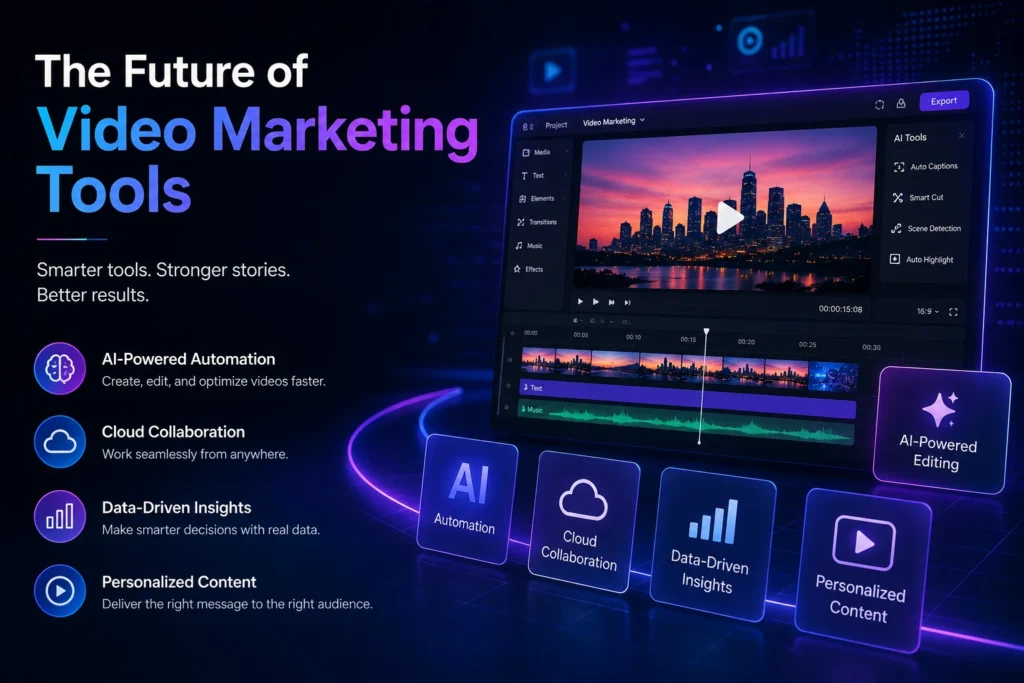
Video marketing technology continues to evolve at an impressive pace, with artificial intelligence leading much of the innovation. Tasks that once required hours of manual editing can now be completed in minutes, allowing marketers to focus more on creativity and strategy than repetitive production work.
AI-powered content generation is expected to become even more sophisticated. Future platforms will likely produce complete marketing videos from simple text prompts, automatically generate multiple versions for different audiences, and personalize content based on viewer preferences. These advancements could make large-scale video production more accessible to businesses of all sizes.
Analytics will also become increasingly intelligent. Rather than simply reporting performance metrics, future video marketing tools may recommend improvements, predict audience behavior, and identify opportunities to increase engagement before campaigns are published.
Interactive video experiences are another growing trend. Features such as clickable elements, embedded product links, personalized calls to action, and shoppable videos are transforming passive viewers into active participants. As these capabilities become more common, marketers will have new ways to engage audiences and shorten the customer journey.
Despite these technological advancements, one principle is unlikely to change. Authentic, valuable, and relevant content will continue to outperform videos that rely solely on automation. The best tools enhance creativity, they do not replace it.
Conclusion
Video has become an essential part of modern digital marketing, and the software you choose plays a significant role in how efficiently you create, manage, and optimize your content. From AI-powered video generators to professional editing suites and advanced hosting platforms, today’s video marketing tools offer solutions for businesses of every size and experience level.
The ideal platform isn’t necessarily the one with the most features, it’s the one that aligns with your goals, fits your workflow, and helps you produce engaging videos consistently. By focusing on usability, collaboration, analytics, scalability, and long-term value, you can invest in software that supports sustainable marketing growth rather than creating unnecessary complexity.
As video continues to shape how brands connect with their audiences, choosing the right tools can help you stay competitive, work more efficiently, and create content that delivers real business results.
FAQs
What are video marketing tools?
Video marketing tools are software applications that help businesses create, edit, publish, host, and analyze videos used for marketing purposes. They simplify the entire production process while improving content quality and campaign performance.
Which video marketing tool is best for beginners?
Canva, InVideo, and CapCut are among the best video marketing tools for beginners. They offer intuitive interfaces, professionally designed templates, and AI-powered editing features, making it easy to create high-quality videos without prior editing experience.
Are AI video marketing tools worth using?
Yes. AI-powered tools can automate repetitive tasks such as generating subtitles, editing videos, creating voiceovers, and transforming text into videos. They save time while making professional-quality video production more accessible.
Should I choose a free or paid video marketing tool?
Free tools are suitable for individuals and small businesses getting started with video marketing. Paid platforms become a better investment as your content strategy grows and requires advanced editing, collaboration, branding, analytics, and automation features.
How do I choose the right video marketing tool for my business?
Start by identifying your marketing objectives, budget, content types, and team requirements. Compare features such as ease of use, AI capabilities, integrations, analytics, collaboration, and scalability before testing the software through a free trial whenever possible.
⚡ Build. Rank. Grow. Follow Spy Growth.