
What Is a Fiber Termination Box? A Detailed Guide for Beginners
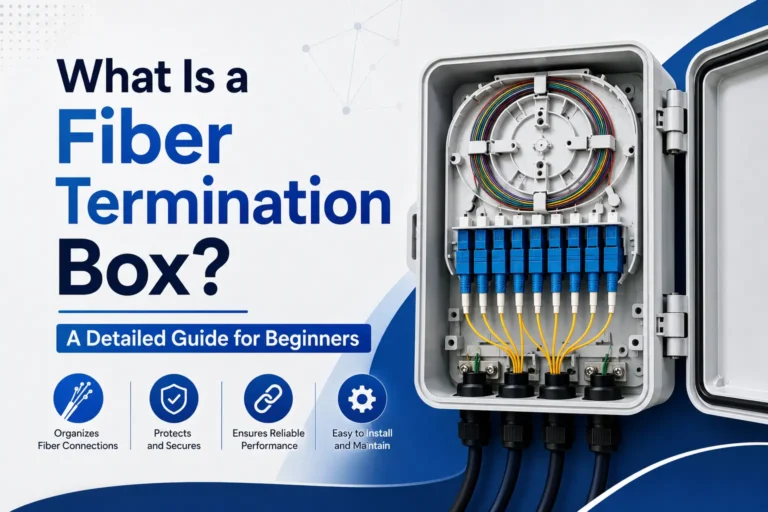
A fiber termination box is a compact enclosure used to terminate, splice, protect, and organize fiber-optic cables. It provides a controlled point where incoming fibers can be connected to adapters, pigtails, or other network equipment without leaving delicate fiber connections exposed.
These boxes are common in FTTH networks, telecom systems, data centers, office buildings, and other fiber-optic installations. Depending on the design, a termination box may support patching, splicing, or both.
What Is a Fiber Termination Box?
A fiber termination box is an enclosure that provides a protected termination point for optical fibers. It keeps the fibers organized while protecting splices, connectors, and cable entries from physical damage.
In a typical installation, the incoming fiber cable enters the box and is secured to prevent unnecessary movement. Individual fibers are then routed to a splice area or termination point. From there, they may connect to fiber pigtails and adapters that provide the external interface for the network.
The exact configuration depends on the application. A small home termination box may simply provide a neat endpoint for an FTTH connection, while a larger enclosure can combine splicing, patching, cable management, and fiber storage in one unit.
The main purpose is straightforward: protect the fiber while making the connection easier to manage, test, maintain, and expand.
How Does a Fiber Termination Box Work?
The process starts when the fiber-optic cable enters the enclosure. The cable is secured at the entry point, while the individual fibers are carefully routed inside the box.
When splicing is required, the incoming fibers are joined to pigtails, usually using fusion splicing. The splice is then protected and stored in a splice tray or cassette. The pigtails can terminate in adapters, allowing technicians to connect and disconnect patch cords without disturbing the permanent splice.
Some systems use factory-prepared pigtailed modules, which combine adapters, pigtails, and splice management into a single assembly. This can simplify installation and reduce field preparation.
Good internal routing is also important. Fiber should be stored with enough slack for maintenance while avoiding bends tighter than the cable or fiber’s specified bend radius. Corning’s installation guidance specifically calls for securing the cable, routing the cable and pigtails to the splice area, and managing slack around the enclosure’s internal guides.
What Are the Main Components of a Fiber Termination Box?
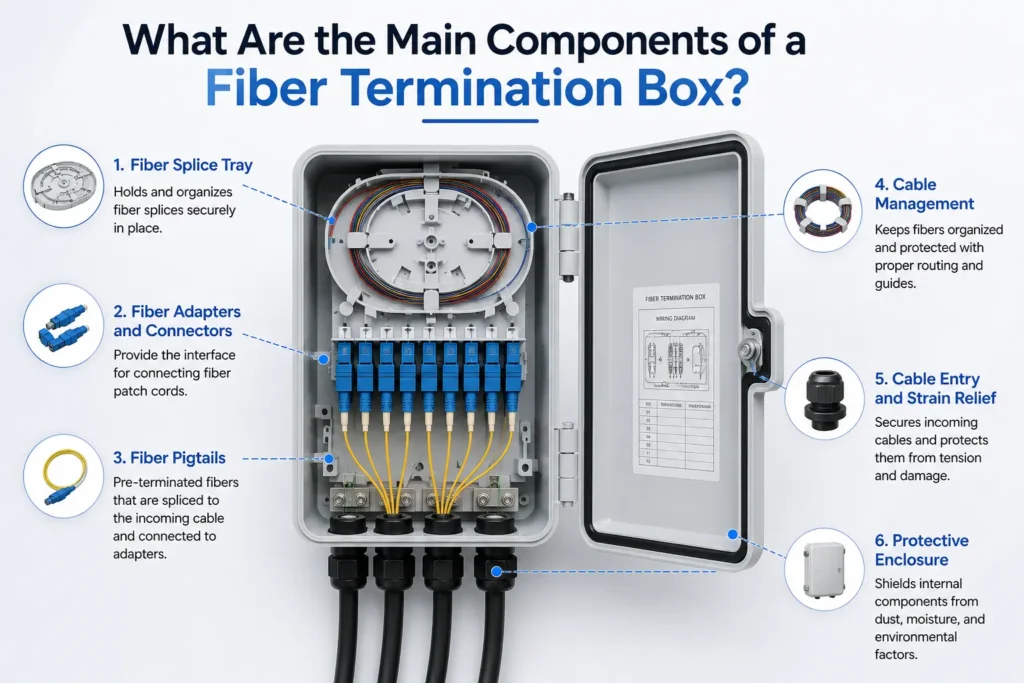
Although designs vary, most fiber termination boxes contain several core elements.
Fiber Splice Tray
A fiber splice tray holds and protects fiber splices. It keeps the splice area organized and prevents the fibers from being exposed to unnecessary stress.
Some termination enclosures are designed specifically around splice trays, while others combine splice storage with connector panels or modular cassettes.
Fiber Adapters and Connectors
Adapters provide the interface where fiber connectors are attached. Common connector formats include SC and LC, although the exact connector depends on the network and equipment.
For example, commercial termination systems are available with SC/APC interfaces for FTTH applications, while high-density data-center housings may use LC duplex adapters.
Fiber Pigtails
A fiber pigtail is a short length of optical fiber with a connector already attached at one end. The other end is spliced to the incoming fiber.
Using pre-terminated pigtails can improve consistency because the connector is factory-installed and tested before installation.
Cable Management
Internal guides, holders, and slack-storage areas keep fibers routed correctly inside the enclosure. This becomes especially important when several fibers are handled in a small space.
Poor routing can increase the risk of excessive bending or accidental fiber damage, so the box should provide enough room for the intended fiber count and installation method.
Cable Entry and Strain Relief
The incoming cable needs to be securely held at the enclosure entry point. Strain relief prevents external pulling forces from being transferred directly to the fibers or splice area.
Some outdoor fiber wall boxes also use sealing systems around cable entries to provide environmental protection.
Protective Enclosure
Finally, the enclosure itself protects the internal connections from accidental contact, dust, and mechanical disturbance. Depending on the application, it may be designed for indoor or outdoor installation.
Where Are Fiber Termination Boxes Used?
Fiber termination boxes are used wherever optical fiber needs a secure and organized connection point.
In FTTH networks, a small termination box can serve as the optical distribution network endpoint at a home or customer location. CommScope, for example, describes its Home Termination Box as an indoor FTTH endpoint used to terminate the ODN at the premises.
In telecom and outside-plant networks, larger wall-mounted boxes can combine patching and splicing while supporting multiple cables and fiber connections. Some designs are suitable for wall or pole mounting and can accommodate significant splice capacity.
They are also used in data centers, wiring closets, office buildings, and network distribution areas, where organized fiber termination makes future maintenance and connection changes easier.
The important point is that a fiber termination box is not defined by one specific size or configuration. Its design depends on the number of fibers, connection method, mounting environment, and network architecture.
Types of Fiber Termination Boxes
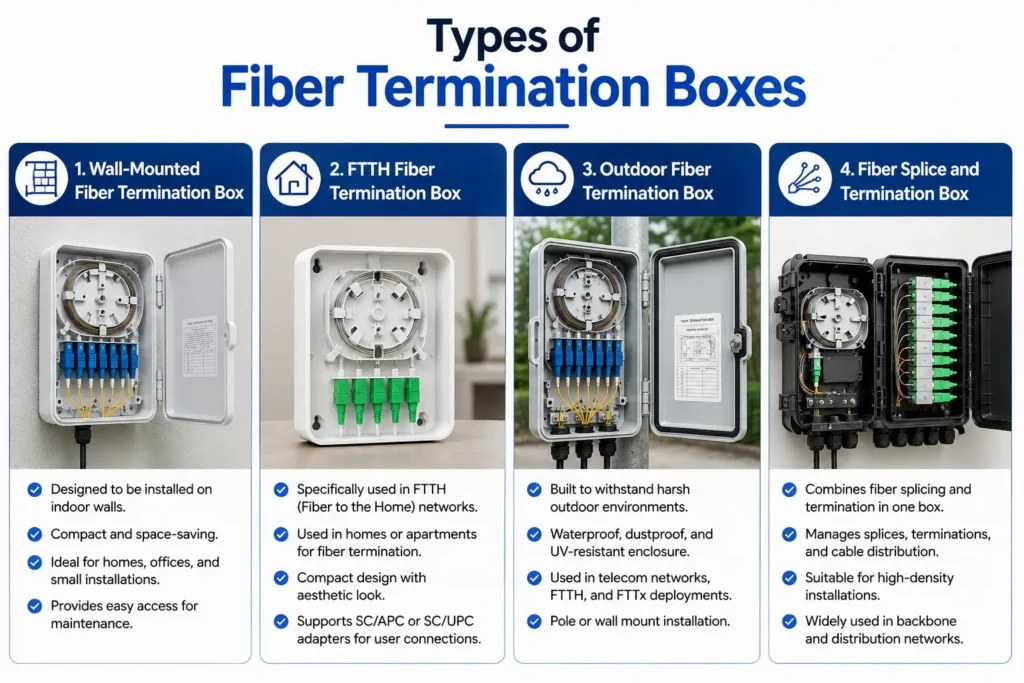
Fiber termination boxes come in different designs because fiber networks are installed in very different environments. The right type depends on the number of fibers, connection method, available space, and whether the box will be installed indoors or outdoors.
Wall-Mounted Fiber Termination Box
A wall-mounted fiber termination box is one of the most common designs for smaller installations. It can be fixed inside buildings, telecom rooms, customer premises, or other network areas where a compact termination point is needed.
These boxes may support both patching and splicing, with some models offering multiple adapter ports and dedicated splice trays. CommScope, for example, offers wall-mounted enclosures designed for FTTH applications with different combinations of adapters, pigtails, and splice capacity.
FTTH Fiber Termination Box
An FTTH fiber termination box is designed specifically for fiber-to-the-home networks. It is usually compact because it often serves as the final connection point between the optical distribution network and the customer’s premises.
A home termination box can sit at the endpoint of the network and provide a protected place for the incoming fiber connection. CommScope describes its HTB3 as an indoor endpoint for terminating the ODN at the home.
Outdoor Fiber Termination Box
Outdoor boxes need additional protection because temperature changes, moisture, dust, and other environmental conditions can affect exposed fiber connections.
These enclosures may use sealed cable entries, weather-resistant construction, and locking covers. Some products are designed for outside-building or harsh indoor environments and protect against rain and water ingress.
Fiber Splice and Termination Box
Some enclosures are designed to handle both fiber splicing and connectorized termination. This is useful when a network needs permanent fiber splices on the incoming side while still requiring accessible connectors for patching.
The capacity can vary significantly. Commercial wall boxes are available with small numbers of ports, while larger models can support many adapters and substantially higher splice counts.
Fiber Termination Box vs. Fiber Splice Box vs. Distribution Box
These terms are often used interchangeably, but they can describe different functions.
A fiber termination box primarily provides a protected point for terminating and organizing optical fibers. It may also include splice management depending on the design.
A fiber splice box places greater emphasis on joining optical fibers. It protects fusion or mechanical splices and provides organized storage for the completed joints.
A fiber distribution box is generally intended to provide a broader connection and distribution function. It may accommodate incoming feeder fibers, outgoing distribution fibers, adapters, splice trays, and, in some network designs, optical splitters.
The distinction is not always absolute because modern fiber enclosures can combine several functions. For example, current wall-mounted products are available with patching, splicing, and splitter configurations in the same enclosure.
How to Install a Fiber Termination Box
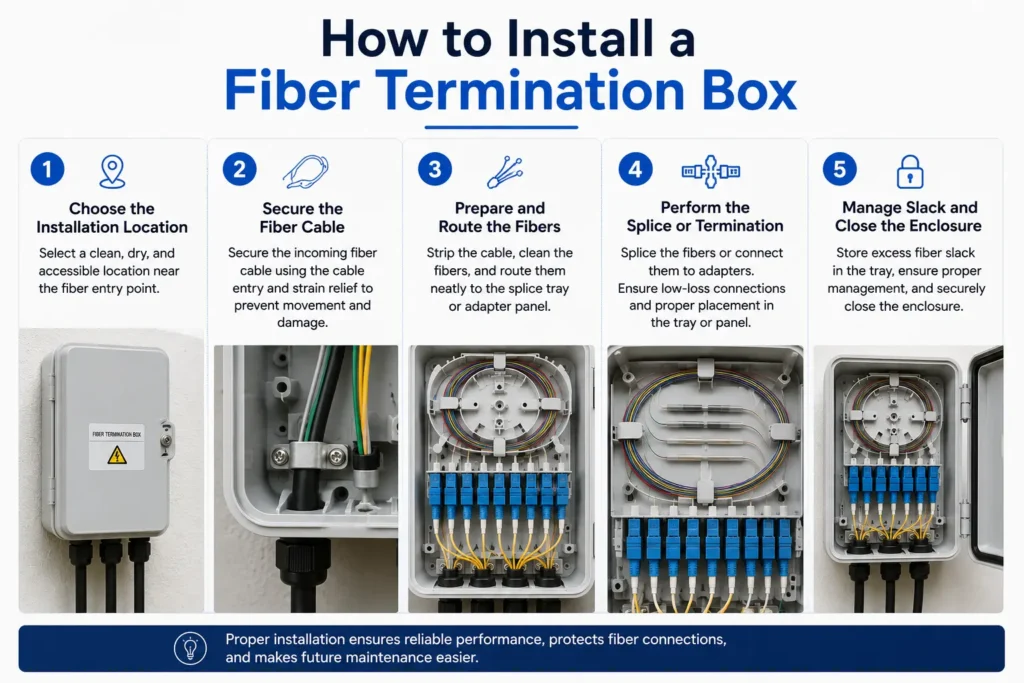
Proper installation is essential because a well-designed enclosure cannot compensate for poor fiber handling.
Choose the Installation Location
Start by selecting a stable and accessible location that matches the box’s intended environment. An indoor box should not be placed where moisture or excessive physical movement is expected, while an outdoor installation should use an enclosure rated for the surrounding conditions.
The location should also leave enough room to open the box and work on the fibers without putting unnecessary pressure on the cable.
Secure the Fiber Cable
Bring the incoming cable into the enclosure through the appropriate cable entry and secure it using the box’s mounting or strain-relief system.
The purpose is to prevent pulling forces from reaching the delicate fibers and internal connections. Many commercial boxes also provide multiple cable-entry options to simplify routing.
Prepare and Route the Fibers
After securing the cable, prepare the individual fibers according to the manufacturer’s installation procedure. The fibers should then be routed through the designated internal guides.
Avoid sharp bends, unnecessary crossings, or excessive pressure. A termination box should provide enough space for the fiber to follow a controlled path while retaining the required slack for future maintenance.
Perform the Splice or Termination
If the design uses splicing, the incoming fiber is joined to a pigtail or another fiber using the specified splicing method. The splice is then placed in the appropriate splice holder or tray.
Where connectorized termination is used, the fibers are connected to the designated adapters or termination modules. The exact process varies with the enclosure and connector type.
Manage Slack and Close the Enclosure
Any required spare fiber should be stored neatly inside the designated slack-management area rather than left loose. This makes future repairs easier and reduces the chance of accidental damage.
Before closing the enclosure, check that the fibers are properly seated, connectors are secure, cable entries are protected, and no fiber is being pinched by the cover. Outdoor models should also have their sealing system properly secured.
A clean installation makes later troubleshooting much easier and helps maintain the mechanical protection the enclosure was designed to provide. Commercial fiber wall boxes commonly include dedicated cable routing, slack storage, and front-access designs for this reason.
How to Choose the Right Fiber Termination Box
The best fiber termination box is not necessarily the largest or most feature-rich model. It should match the actual requirements of the network.
Start with fiber and port capacity. A box with too little capacity can become difficult to manage as the network grows, while an unnecessarily large enclosure can waste space and money.
Next, consider whether the installation requires splicing, patching, or both. Connector type is equally important because the box must support the adapters and patch cords used by the network.
The installation environment also matters. Indoor applications may only require basic physical protection, while outdoor deployments can require a sealed, weather-resistant enclosure. Mounting method, cable-entry options, splice capacity, and room for future expansion should also be considered before making a selection.
In practice, choosing the box around the network architecture is more reliable than choosing it based only on appearance or price.
Fiber Termination Box Specifications to Check
Choosing a fiber termination box should start with the network requirements rather than the physical appearance of the enclosure. Fiber count is one of the first things to consider. The box should have enough ports and internal space for the current installation without making future expansion unnecessarily difficult.
The splice capacity also matters when the incoming fibers will be joined to pigtails. Different enclosures support different numbers of splices, adapters, and modules, so the specification should match the actual fiber count.
The connector type is another important consideration. SC, LC, and other connector formats are not interchangeable, and the adapters inside the termination box must match the connectors being used in the network.
Installation conditions should be considered as well. An indoor box may only need basic mechanical protection, while an outdoor enclosure may need sealing and environmental protection against moisture and dust. The mounting method, cable-entry design, available slack storage, and overall dimensions should also fit the installation area.
It is equally important to check the manufacturer’s recommended bend radius. Fiber cables should not be routed around excessively tight corners inside the enclosure. Corning’s installation guidance specifically advises routing cable slack around internal guides while maintaining the cable’s recommended bend radius.
Common Fiber Termination Box Problems
Most problems with a fiber termination box are not caused by the box itself. They usually result from poor installation, damaged connectors, improper fiber routing, or inadequate maintenance.
Poor fiber management can leave fibers crossing over one another or pressed against the enclosure. Over time, unnecessary stress can affect the cable and make future troubleshooting more difficult.
Excessive bending is another common issue. Fiber can tolerate normal routing, but forcing a cable into a tight space can exceed its specified bend radius. The result may be increased optical loss or physical damage.
Dirty connectors are especially important because even small particles can affect optical performance. Corning recommends cleaning connectors before testing or inserting them into an adapter, while Fluke Networks recommends inspecting connector end faces before connection.
Loose cable entries, crushed cables, damaged seals, and overloaded enclosures can create additional problems. These issues are easier to prevent when the termination box is selected with enough capacity and installed according to the manufacturer’s instructions.
Fiber Termination Box Maintenance
A fiber termination box generally requires little routine maintenance, but periodic inspection can prevent small issues from becoming network failures.
Start by checking the cable entry points and internal routing. Make sure the fiber is not being crushed, pulled, or bent beyond the recommended limit. Corning’s maintenance guidance also recommends checking cable entries and exits for damage and inspecting the overall condition of the enclosure.
Fiber connectors should remain clean whenever they are connected or tested. A connector that looks clean to the eye can still contain contamination at the end face, so inspection and appropriate cleaning procedures are important before making a connection.
Labels should also remain clear and accurate. Proper identification becomes valuable when a network contains many fibers because technicians can trace the correct connection without unnecessarily disturbing other cables.
For outdoor installations, inspect the enclosure, cable entries, seals, and mounting hardware for signs of damage or environmental wear. Any issue that compromises the enclosure’s protection should be addressed according to the manufacturer’s maintenance procedure.
FAQs
What is a fiber termination box?
A fiber termination box is a protective enclosure used to organize and terminate fiber-optic cables. Depending on its design, it can also contain splice trays, adapters, pigtails, and fiber-management components.
What is the difference between a fiber termination box and a splice box?
A termination box focuses on providing a protected connection and termination point for fibers, while a splice box is primarily designed to protect and organize fiber splices. Some modern enclosures combine both functions.
Can a fiber termination box be used outdoors?
Yes, but the enclosure must be specifically designed and rated for outdoor conditions. Outdoor models generally provide better environmental protection and suitable cable-entry systems than basic indoor boxes.
How many fibers does a fiber termination box hold?
Capacity varies by model. Small FTTH boxes may support only a few connections, while larger wall-mounted or distribution enclosures can accommodate substantially more fibers, adapters, and splices. The required capacity should be based on the network’s present and expected fiber count.
How do I choose the right fiber termination box?
Consider the fiber count, connector type, splice requirements, mounting method, cable dimensions, installation environment, available space, and room for future expansion. The box should also provide suitable internal fiber management and maintain the cable’s specified bend radius.
Conclusion
A fiber termination box provides a practical and protected point for managing fiber-optic connections. By keeping cables, splices, pigtails, and connectors organized, it makes fiber networks easier to install, maintain, and troubleshoot.
The right enclosure depends on the application. FTTH installations may need a compact customer-side box, while telecom and larger distribution networks may require an enclosure with greater splice, port, and cable-management capacity.
Good results ultimately depend on more than choosing the correct box. Proper cable routing, bend-radius control, clean connector end faces, secure cable entries, accurate labeling, and regular inspection all contribute to a reliable fiber connection.
💡 Learn today. Rank tomorrow. Follow Spy Growth.